All links have been updated.
Thursday, 4 May 2017

Wednesday, 3 May 2017
Very, very bad news...
Due to the blocking of my Yandex.Disk account, all files are temporarily unavailable for downloading. In the near future I will try to fix everything.
Thursday, 6 April 2017



Wednesday, 5 April 2017


Thursday, 9 March 2017
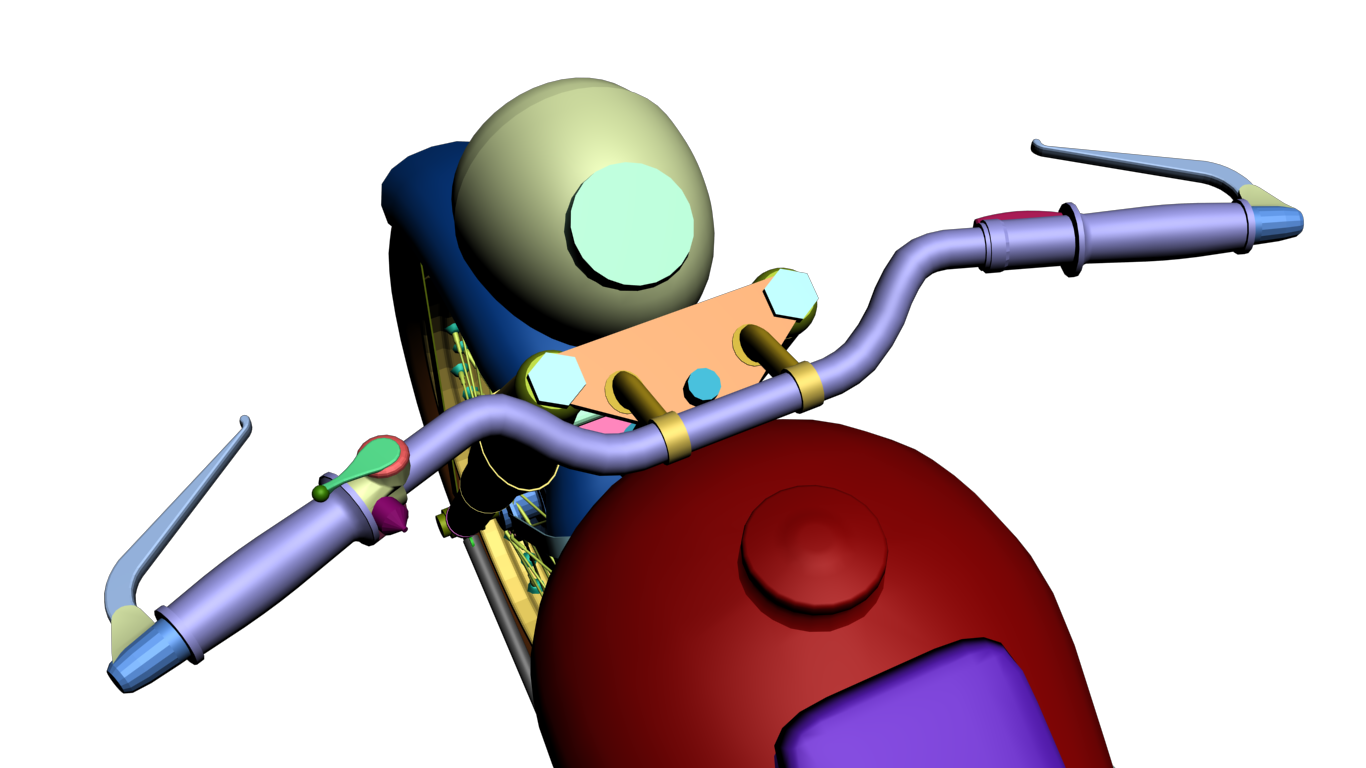
[WIP] IMZ M-72
Before the outbreak of World War II, a broad program of mechanization and motorization of the Red Army was launched in the USSR. Under this program, it was envisaged to begin equipping the army with three-axle and four-wheel-drive vehicles, as well as specially created for the army motorcycles.
Due to the fact that the motorcycles produced for that time in the country were not suitable due to the weakness of the construction and the lack of reliability for military vehicles, the Soviet government decided to produce a new heavy road motorcycle with an engine capacity of 750 cubic centimeters. Since the new motorcycle was required as they say in Russia "yesterday", it was decided not to create it from scratch, but to copy the already existing most suitable for Russian conditions design. Work began in 1940 in a special design bureau of the experimental plant Iskra in Moscow.
The head of the bureau, N.P. Serdyukov, who underwent an internship at the BMW factory from 1935 to 1940, offered a BMW R71 motorcycle as a model, which by that time had proved itself well in the Wehrmacht. But the choice at first glance seems rather unusual: the most massive motorcycle in the Wehrmacht was a BMW R12 motorcycle, when the R71 was only released 3,500 units. The Germans were frightened by the complicated and expensive back candle suspension for that time. The Russians also operated with ideas about reliability, unpretentiousness, cheapness of mass production and, first of all, the possibility of subsequent modernization.
There are two and a half versions of how the R71 got into the Soviet Union. In the first, the Russians simply bought five motorcycles in Sweden. According to the version of one and a half Germans sent the same 5 motorcycles to Sweden for testing in the mountains, but only three returned, two motorcycles disappeared without a trace, obviously not without the help of the Soviet special services. According to the second version, which is more prosaic, in 1940 the Soviet heavy motorcycle TIZ-AM-600, PMZ-750 and BMW R71 were tested. The first two, although they were in service, but as mentioned above, did not suit the military in terms of reliability.
So, the production of the M-72 began in 1941 at the plant MMZ (Moscow Motorcycle Plant), engines were produced at the ZIS plant (formerly AMO, later ZIL, AMO ZIL), at the KIM plant (the Plant of the Communist International, the future MZMA and AZLK ) - gearbox, GAZ (Gorky Automobile Plant) produced cardan shafts and a trailer. MMZ produced these motorcycles until 1951. In 1942, the production of motorcycle parts with MMZ, KIM, ZIS was evacuated to the city of Irbit, that in the Urals. The Design Bureau also moved to Irbit. Production was started at the Gorky factory "Red Etna" (it is also called the Gorky motorcycle factory). After the war in 1951, in parallel with the IMZ (Irbit Motorcycle Plant), production began in Kiev (Kiev Motorcycle Plant), but later it went its own way of developing the design.
Motorcycle M-72 was made before 1960, and in 1955 after modernization it began to be sold to the population. In total, during the production period, 330 thousand motorcycles were produced.
By design, the motorcycle was virtually identical to the BMW R71.
The M-72 was considered to be the weapon carrier, thanks to the possibility of installing a DP machine gun on the wheelchair bracket (during the war, a modification was also supplied to the troops with a site for the installation of a 82-mm mortar instead of a stroller), so all the motorcycles were registered in the war machines and were to be mobilized in case war.
Thanks to the use of the opposite engine, the M-72 had a low center of gravity, and therefore better stability and patency, but the outreach of the cylinders increased the lateral dimension.


Due to the fact that the motorcycles produced for that time in the country were not suitable due to the weakness of the construction and the lack of reliability for military vehicles, the Soviet government decided to produce a new heavy road motorcycle with an engine capacity of 750 cubic centimeters. Since the new motorcycle was required as they say in Russia "yesterday", it was decided not to create it from scratch, but to copy the already existing most suitable for Russian conditions design. Work began in 1940 in a special design bureau of the experimental plant Iskra in Moscow.
The head of the bureau, N.P. Serdyukov, who underwent an internship at the BMW factory from 1935 to 1940, offered a BMW R71 motorcycle as a model, which by that time had proved itself well in the Wehrmacht. But the choice at first glance seems rather unusual: the most massive motorcycle in the Wehrmacht was a BMW R12 motorcycle, when the R71 was only released 3,500 units. The Germans were frightened by the complicated and expensive back candle suspension for that time. The Russians also operated with ideas about reliability, unpretentiousness, cheapness of mass production and, first of all, the possibility of subsequent modernization.
There are two and a half versions of how the R71 got into the Soviet Union. In the first, the Russians simply bought five motorcycles in Sweden. According to the version of one and a half Germans sent the same 5 motorcycles to Sweden for testing in the mountains, but only three returned, two motorcycles disappeared without a trace, obviously not without the help of the Soviet special services. According to the second version, which is more prosaic, in 1940 the Soviet heavy motorcycle TIZ-AM-600, PMZ-750 and BMW R71 were tested. The first two, although they were in service, but as mentioned above, did not suit the military in terms of reliability.
So, the production of the M-72 began in 1941 at the plant MMZ (Moscow Motorcycle Plant), engines were produced at the ZIS plant (formerly AMO, later ZIL, AMO ZIL), at the KIM plant (the Plant of the Communist International, the future MZMA and AZLK ) - gearbox, GAZ (Gorky Automobile Plant) produced cardan shafts and a trailer. MMZ produced these motorcycles until 1951. In 1942, the production of motorcycle parts with MMZ, KIM, ZIS was evacuated to the city of Irbit, that in the Urals. The Design Bureau also moved to Irbit. Production was started at the Gorky factory "Red Etna" (it is also called the Gorky motorcycle factory). After the war in 1951, in parallel with the IMZ (Irbit Motorcycle Plant), production began in Kiev (Kiev Motorcycle Plant), but later it went its own way of developing the design.
Motorcycle M-72 was made before 1960, and in 1955 after modernization it began to be sold to the population. In total, during the production period, 330 thousand motorcycles were produced.
By design, the motorcycle was virtually identical to the BMW R71.
The M-72 was considered to be the weapon carrier, thanks to the possibility of installing a DP machine gun on the wheelchair bracket (during the war, a modification was also supplied to the troops with a site for the installation of a 82-mm mortar instead of a stroller), so all the motorcycles were registered in the war machines and were to be mobilized in case war.
Thanks to the use of the opposite engine, the M-72 had a low center of gravity, and therefore better stability and patency, but the outreach of the cylinders increased the lateral dimension.



Sunday, 22 January 2017
[REL, ST] 1940 GAZ-MM
GAZ-MM for SpinTires is ended.
http://steamcommunity.com/sharedfiles/filedetails/?id=808811281
http://steamcommunity.com/sharedfiles/filedetails/?id=808811281
Thursday, 12 January 2017
[REL] 1934 GAZ-AAA
So, I present my new conversion - Soviet 2-ton truck GAZ-AAA (as in the previous conversion, the basis was taken a polutorka from Red Orchestra 2: Heroes of Stalingrad)which is a modification GAZ-AA with 6x4. This model is a specification until 1937. The screenshots - version with IVF, the archive is also a model for standard lights.
Model features:
* Unlike other conversions - cabin normally painted
* Good quality of model and textures
* A large number of parts made by me from scratch - wheel, engine, transmission, brake system, engine compartment, headlights, hoods. Reworked board platform, the elements of the frame and cab.
*A model adapted to the of IVF (headlights, brake lights, brake calipers) and Active Dashboard (wiper, steering wheel)
* CJ's hands on the steering wheel
* New settings (handling.cfg, vehicle.ide, carcols.dat). Described in the ReadMe.
* All that has, breaks, scratches, beats. Exploding gas tank (the neck in front of the windshield)
* New shadow, collision, сhassis_vlo
* It is possible to hitch a trailer (seen in the screenshot)
* Replaces Sadler
Thank you:
* DK22Pac for creating Improved Vehicles Features
* Izerli for creating Active dashboard


Model features:
* Unlike other conversions - cabin normally painted
* Good quality of model and textures
* A large number of parts made by me from scratch - wheel, engine, transmission, brake system, engine compartment, headlights, hoods. Reworked board platform, the elements of the frame and cab.
*A model adapted to the of IVF (headlights, brake lights, brake calipers) and Active Dashboard (wiper, steering wheel)
* CJ's hands on the steering wheel
* New settings (handling.cfg, vehicle.ide, carcols.dat). Described in the ReadMe.
* All that has, breaks, scratches, beats. Exploding gas tank (the neck in front of the windshield)
* New shadow, collision, сhassis_vlo
* It is possible to hitch a trailer (seen in the screenshot)
* Replaces Sadler
Thank you:
* DK22Pac for creating Improved Vehicles Features
* Izerli for creating Active dashboard


Subscribe to:
Posts (Atom)
[REL] 1930 Ford Model A Standart Fordor
1930 Ford Model A with a Standart Fordor body, which was produced by the body firm Briggs. What it has: the chassis is completely modeled f...

-
 1930 Ford Model A with a Standart Fordor body, which was produced by the body firm Briggs. What it has: the chassis is completely modeled f...
 -
 So, i'm realise my new conversation - Dodge Monaco V8 7.2L 1974 model year from Driver: San Francisco both the civil and the police vers...
 -
 Began work on the Smith Thunderbolt from Mafia II. As can be seen by the render, mainly texture applied. You're all set up GTA-material...